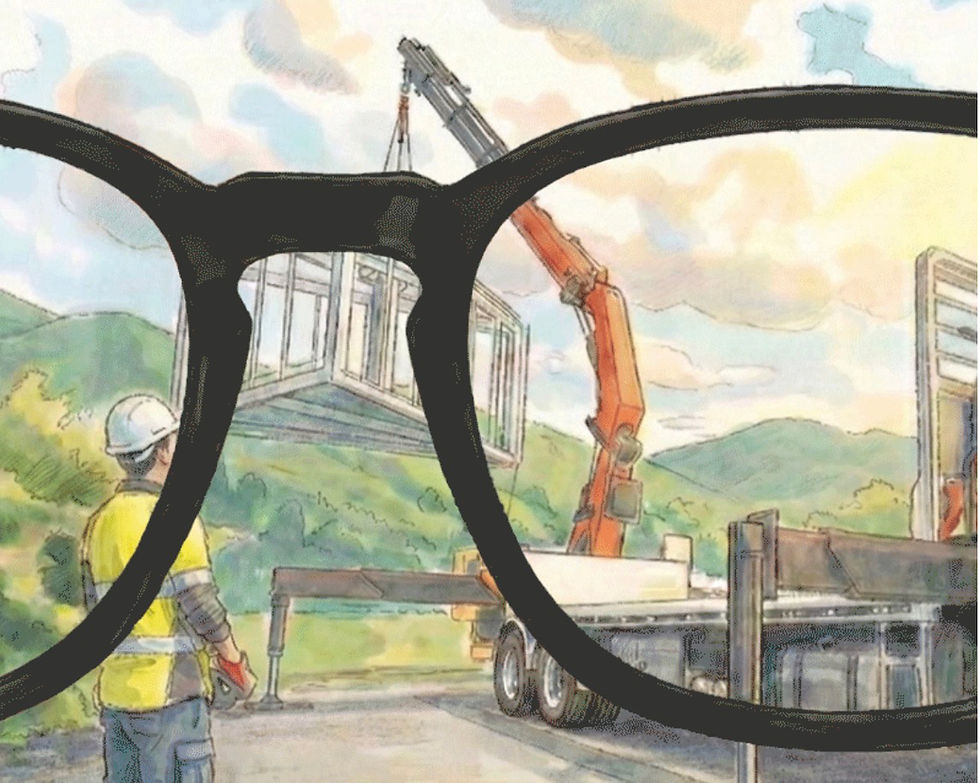
Magic Glasses: Fatigue
Fatigue decisions are rarely made by careless people. They are made on busy sites, under time pressure, with money on the line and a job that feels close to done. Without the Magic Glasses, continuing feels normal. With the Magic Glasses on, you can see how a “reasonable” decision today becomes the root cause of harm tomorrow. The difference is not intent. It is judgement.

Quick Scene-Setter
A mobile crane has been on site since early morning. The job has momentum. Lifts are flowing. The programme is tight.
Delays earlier in the day mean the work is running late. Fatigue limits are approaching, but the job is not finished.
Another supplier is willing to continue.
They do not see fatigue as a reason to change how the job is being run.
What Most People See
At first glance, pushing on looks reasonable:
The crane is already set up.
The operator knows the job.
The customer wants continuity.
Dispatch wants to avoid disruption.
Nothing looks unsafe.
It feels like progress.

Why Everyone Wants to Keep Rowing Forward
This is where fatigue becomes invisible, because incentives align.
The Crane Company
If the same operator continues:
The job keeps moving with no operator handover.
There is no need to replan logistics or bring in relief.
The crane earns more hours with minimal additional cost.
This is a commercial advantage for the company that is willing to push on.
The Operator
For the operator:
Overtime is valuable and often paid at a higher rate.
Fatigue builds gradually.
The incentive is to keep working, not to raise the alarm.
This is why fatigue is rarely self-reported reliably. No one's looking...
The Customer or Subcontractor
For the customer or subcontractor:
The crane is a tool. The output is what matters.
A handover feels like a delay.
Programme and turnaround pressure dominate.
No visibility or knowledge of NZTA Worktime rules.
Everyone wants the same thing: keep moving.
What the Magic Glasses Show You
The Magic Glasses zoom out and show what the momentum hides.
They show:
Over 13 work hours in a day is a fatigue hazard.
Over 70 work hours in a week is a fatigue hazard.
Reaction time, attention and decision quality dropping quietly.
A worker who must still drive on public roads at the end of the shift.
Fatigue does not need drama to create harm. It only needs one moment of reduced judgement.

The Waterfall Ahead
Most fatigue harm happens after the work “went well”:
On the drive home.
At a familiar intersection.
When a routine situation calls for a quick decision.
That is why fatigue becomes a root cause. The lift finishes, and the risk follows the operator onto the road.
The Logbook Myth and the Paper Trail
A common belief still appears with Mobile Crane Companies:
“NZTA Logbooks do not apply, so fatigue rules do not apply.”
The Magic Glasses show the problem.
Even when logbooks are not required, the truth is still recorded:
Pay records
Timesheets
Dispatch records
Job start and finish times
Crane companies are already logging the reality. In the event of a serious incident, those records are used to reconstruct hours and decisions. The absence of a logbook does not remove accountability. It only delays when the facts are examined.
Overlapping Duties: Who Owns the Risk?
Fatigue is not owned by one party. It sits across multiple PCBUs:
The crane company
The principal contractor
The customer
The subcontractor
When everyone benefits from pushing on, fatigue can fall between responsibilities. Each party assumes the other party is managing it.
The Magic Glasses question is simple:
Who is actively controlling fatigue on this job, right now?
What Good Dispatch and Planning Looks Like
Good fatigue management does not mean the job must stop. It means the job must not continue with a fatigued operator.
Good dispatch:
Treats the crane as the hired asset, not the exhausted person.
Swaps operators to keep someone fresh in the seat.
Plans relief coverage for jobs that run long.
Supports operators to call fatigue early without pressure.
Good dispatch swaps the operator, and the job continues. Bad dispatch keeps the same operator going.
People hire the crane. The operator is a control measure, not a consumable.
When Doing the Right Thing Costs Work
Sometimes managing fatigue means saying no, and losing the job to a competitor who will keep going.
That is not a weakness in fatigue management. It is a sign that industry culture is miscalibrated.
If the market rewards risk tolerance, unsafe continuation becomes normal. The Magic Glasses are a way to correct that calibration, one decision at a time.
Magic Glasses Checklist – Fatigue and Momentum
Before pushing on, ask:
How many hours has the operator worked today, including time spent in the work vehicle?
Are we near or over 13 Worktime hours?
What does the weekly total look like? Are we near or over 70?
Are we competing on capability, or risk tolerance?
Can we swap operators and keep the job moving?
Who is actively managing fatigue across all PCBUs on this job?
Will this decision stand up after an investigation?
Fatigue is not a personal weakness. It is a predictable hazard that grows with momentum and pressure. The Magic Glasses do not tell you to stop rowing. They tell you to look ahead and act before the waterfall. When you can see fatigue clearly, you can control it, keep the job moving, and still get people home safely.
FAQ NZTA Worktime Rule
It's been around for a long time. Yes, it applies to Mobile Crane Operations - but it's also a good basis for your own fatigue management system. It's proven and works.
Why only Mobile Crane Operators? The trigger is driving a heavy vehicle on the road. You trigger the Worktime Rule as Mobile Cranes are a Heavy Vehicle.
Why don't Mobile Crane Operators have to do a Logbook?
Under the Worktime Rule, Mobile Crane Operators have an exemption from the log book - but not from worktime.
Magic Glasses: The magic glasses come from the reality of - when I look at my books, I don't see a problem. But when my accountant looks at the books, it's a whole different story. He must have a special set of glasses.
As PCBU's, Officers and Workers, we have an obligation to learn what we are up to and the risks. Our actions and the standards we accept also affect those around us. This magic glasses post is made to help others see what we see.