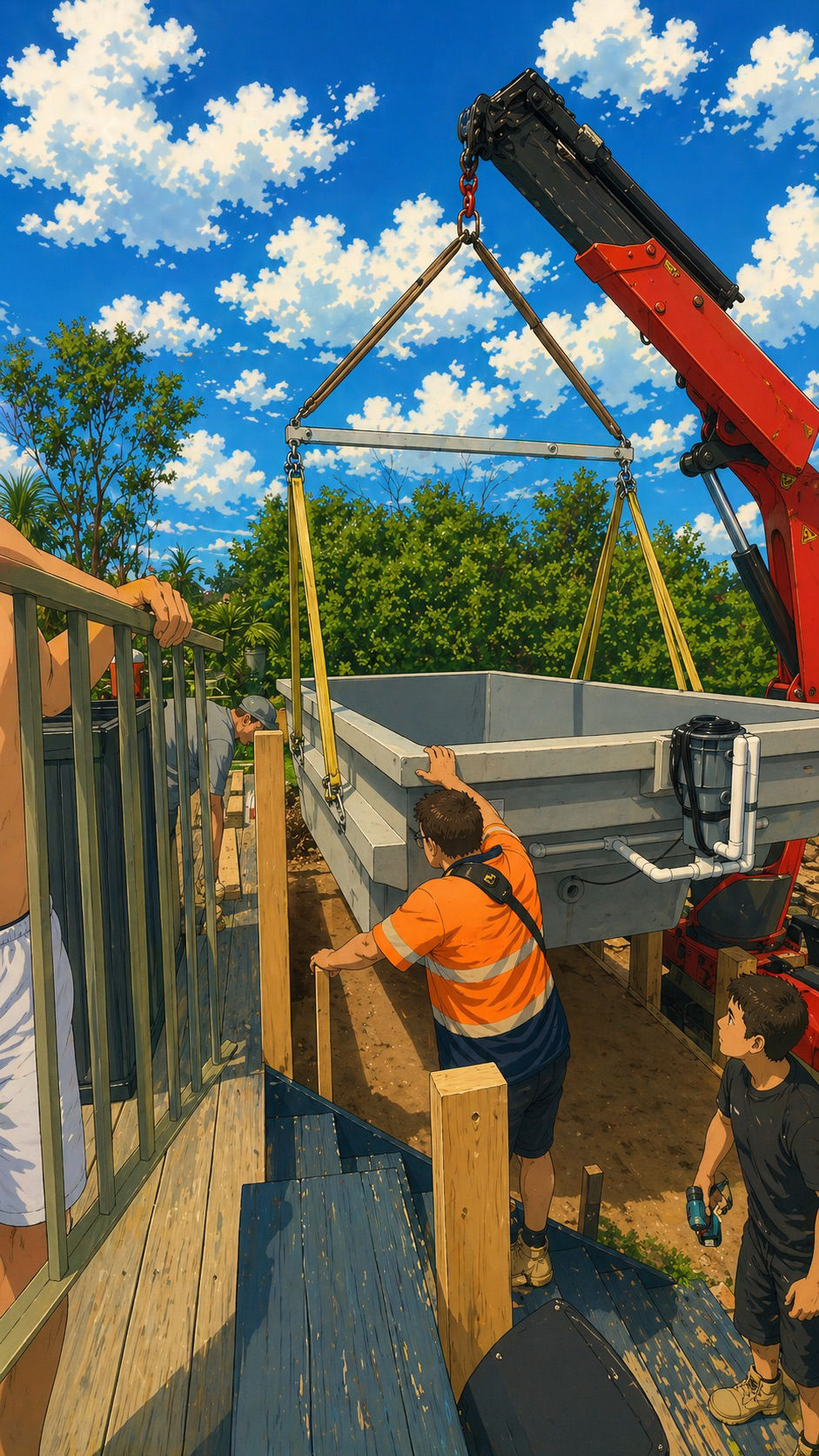
Magic Glasses: Non-Returnable Lifts From Height
At first glance, it appears to be a straightforward removal. The crane just has to lower the load.
Put on the Magic Glasses, and you see the real issue: once the load is released, it’s non-returnable. From that moment on, the load belongs to the crane until it’s on the ground. There is no safe reset. No way back.
Quick Scene-Setter
A load must be removed from height and lowered to the ground - plant, steel, ducting, precast, or temporary works.
The crane connects at height.
Supports are released.
From that point forward, the lift is non-returnable. The load cannot be parked, re-set, or re-rigged. It has one safe destination: the ground.

What Most People See
A first-look view often sounds like this:
“The crane can lift it.”
“It'll be strong enough.”
“The lift points look OK.”
“Once it’s free, we just lower it.”
“If it moves, we’ll deal with it.”
The underlying assumption?
That control can always be recovered once the lift begins.

But This Isn’t a Lift From the Ground
Lifts from ground level often allow:
Re-seating if the load shifts
Pausing and adjusting rigging
Visual access to all sides
Immediate support if something changes
Lifts from height - especially non-returnable ones - do not.
Once released:
There’s no way back
No access for correction
No recovery from error
A lift from height is not a lift from the ground. It’s a one-way movement with no second chance.
What the Magic Glasses Show You
When you put the Magic Glasses on, you don’t see complexity - you see what’s missing.
1) There is no engineered lift plan
The lift relies on “how we normally do it.”
Release behaviour hasn’t been analysed.
No one has defined what happens at the moment of release.
There’s no lift-and-hold step built in.
If the release is the highest-risk moment, it cannot be unmanaged.
2) The weight is assumed, not verified
Once free, the load generally cannot:
be re-seated at height,
be re-rigged safely,
be parked on a structure,
be paused mid-air to reassess.
Any error occurs while the load is suspended, and you have no practical way back.
3) Lift criticality is about consequence, not mass
Weight take-offs are based on drawings or memory.
Fixings, rigging, attachments, or debris may be missing from the estimate.
The centre of gravity is guessed.
No peer review has occurred.
Calculated weights shall not be used directly for lift planning without an explicit contingency allowance reflecting known and unknown uncertainties.
In a non-returnable lift, assumed weight distribution = real hazard.
4) Crane capacity is marginal
The crane “just works” on the chart.
Rigging and load weight bring it near the limit.
There’s no capacity buffer for binding, swing, or shock.
The lift depends on everything behaving perfectly.
Non-returnable lifts don’t forgive tight margins.
5) Release behaviour hasn’t been controlled
Last bolts, welds, or restraints are released without sequencing.
The load could snag, bind, or rotate unexpectedly.
The first movement isn’t planned or observed.
Cutting or breakout is treated as routine.
The most dangerous part of the lift is being treated casually.
6) The structure and lift points may not be verified
The item looks solid, but hasn’t been assessed for lifting.
Lift points are assumed adequate - not engineered.
Welds, inserts, or anchorages may not be designed for load direction.
No one has confirmed that the item won’t bend, twist, or crack on release.
If the lift points or structure fail under load, there’s no recovery - just failure mid-air.
Non-Returnable Lifts - Capacity Margins and Control
Non-returnable lifts from height require explicit, conservative capacity margins, particularly when release behaviour cannot be fully controlled. These margins are a risk control, not a design factor.
Crane Capacity Margins
Non-returnable or uncertain behaviour
Where the load cannot be safely returned, or release behaviour is uncertain (e.g. cutting, snagging, partial support), apply a minimum 2.0× crane capacity margin - unless lift engineering demonstrates otherwise.
Fully engineered lifts
Capacity margins may be reduced where justified by documented lift engineering, including:
dynamic amplification
load stability and eccentricity
release sequence and load transfer
crane configuration sensitivity
“You don’t reduce margin by confidence. You reduce margin by eliminating uncertainty.”
The adopted margin must be explicit and justified. Weight uncertainty is one of the primary root causes of lift failure. Relying solely on chart capacity is not acceptable.
Component | Engineering Requirement / Basis |
Crane capacity - non-returnable | ≥ 2.0× the maximum credible suspended load, including rigging and attachments, where weight, COG, or release behaviour are not fully quantified |
Crane capacity - engineered non-returnable | Capacity derived from documented lift engineering, including quantified load, COG, release sequence, and dynamic effects, with appropriate dynamic amplification allowance (typically 1.2–1.5×) consistent with AS 1418.1 |
Rigging | Selected, configured, and rated to applicable standards and duty class, with leg load distribution, angles, and redundancy considered for the governing lift condition |
Lifting attachments | Designed specifically for lifting load cases with ≥ 1.5× ULS factor, consistent with AS/NZS 4991 |
Dynamic Amplification (DAF) | 1.2–1.5× applied where dynamic effects cannot be explicitly calculated, including release, breakaway, or transient motion, consistent with AS 1418.1 |
Structural check of load/lift points | Structure and lift points verified for lifting load cases, including non-gravity load directions and local effects, using safety factors consistent with AS/NZS 4991 |
Crane capacity margin does not compensate for inadequate rigging, lift point failure, or structural inadequacy of the load, which must be addressed independently.
Controls That Matter
🔸 Verify the weight and CG
A competent person completes the weight take-off
Includes rigging, fixings, attachments, debris
Centre of gravity is confirmed, not estimated
Peer-reviewed before the lift plan is finalised
Weight uncertainty is a primary root cause of lift failure.
🔸 Engineer the release - or overcompensate
Use engineered planning or build in a larger capacity margin
Model load path, friction breakaway, swing potential
Design bumpers, guides, or support where possible
Sequence release to avoid unplanned load transfer
🔸 Respect the final cut
The person removing the final support, bolt, or weld must know:
- exactly what will happen when it releases
- that the crane is ready and holding the load
- that no part of the structure will bind or rotate unexpectedly
No one should release a load they don’t fully understand.
🔸 Control the drop zone and landing
Exclusion zone covers the full fall envelope, not just the landing spot
Access routes are actively monitored
Ground conditions and dunnage confirmed before lift begins
🔸 Establish stop-work authority
Before starting:
Nominate a single lift director
Confirm that anyone can call STOP
Define clear triggers - delayed release, swing, loss of control
Non-returnable lifts fail fast when authority is vague and stop-work is hesitant.
🔸 Authority replaces improvisation
High-hazard industries manage non-returnable lifts using:
formal lift classification
engineering sign-off
procedural hold points
clear stop-work authority
These controls exist because non-returnable lifts fail quickly when planning is replaced by improvisation.
At McLeod, these are considered contract lifts, where our engineering team is engaged early in the process. It’s not left to the on-site team to decide on the day.
Magic Glasses Checklist - Non-Returnable Lifts
Is this lift truly non-returnable once released?
Is there an engineered release sequence - not just a lift plan?
Has the load weight been verified and peer-reviewed?
Is the COG confirmed?
Are rigging and lifting points engineered or certified?
Is the structure verified for lifting forces in accordance with AS/NZS 4991?
Is there a 2× margin (or engineered equivalent)?
Is the drop zone actively controlled?
Is the landing area ready?
Is the stop-work authority clear, with known triggers?
Is there any way back?
Either eliminate uncertainty through engineering, or compensate for it through margin.
If neither is done, the lift is not ready.
Magic Glasses: The magic glasses come from the reality of - when I look at my books, I don't see a problem. But when my accountant looks at the books, it's a whole different story. He must have a special set of glasses.
As PCBU's, Officers and Workers, we have an obligation to learn what we are up to and the risks. Our actions and the standards we accept also affect those around us. This magic glasses post is made to help others see what we see.