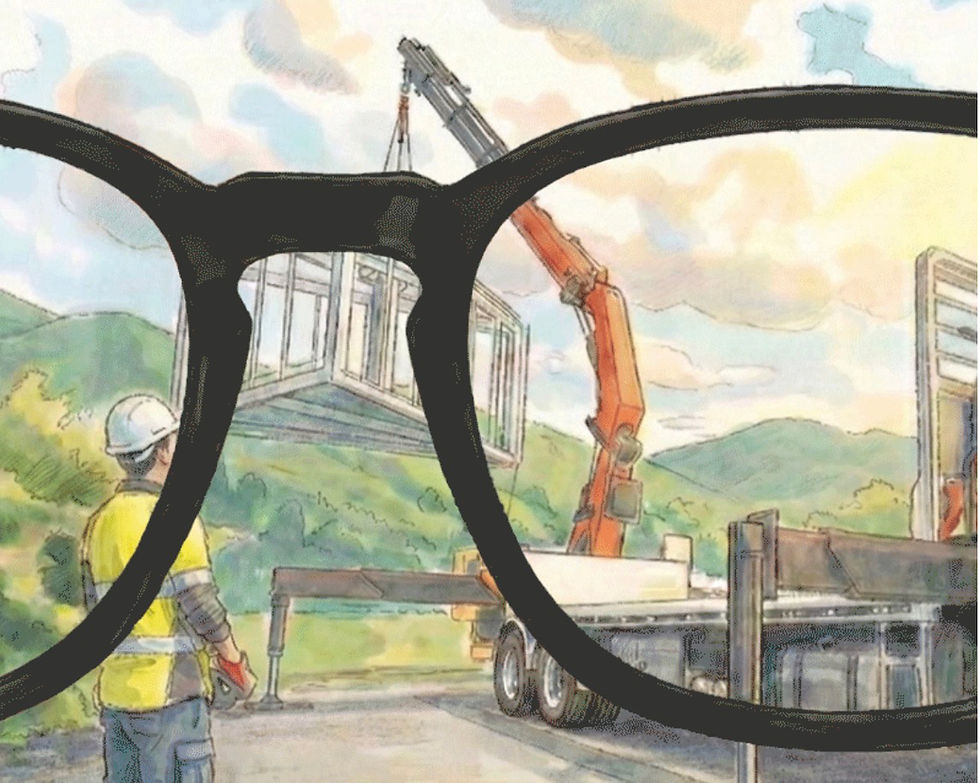
Magic Glasses: Hiab Stabilisers, Pads, and Ground Bearing Pressure
Updated: Jan 26
At first glance, a Hiab set up on its stabilisers can look solid and ready to work. Put on the Magic Glasses, and you start thinking about what the ground is doing under each stabiliser. Experience teaches you that stability is not just about the crane. It is about how the load is transferred into the ground.
Quick Scene-Setter
A Hiab arrives on site to unload building materials.
The truck is parked on what appears to be firm ground or a sealed surface.
The stabilisers are deployed, and the truck feels steady.
The pads are on the truck, but the operator considers lifting without them.
Everything looks fine.

What Most People See
Most people focus on what they can see:
The stabilisers are fully extended.
The truck looks level.
The load is well within the Hiab’s rated capacity.
The ground looks hard enough.
From this view, stabiliser pads feel optional, especially on concrete, asphalt, or compacted gravel.
What the Magic Glasses Show You

A trained eye sees something different:
Hiab stabilisers apply very high point loads into a small contact area.
Even sealed surfaces can fail, crack, or punch through under concentrated load.
Fill, voids, services, or edge conditions may sit just below the surface.
Ground bearing pressure increases quickly as the reach and load increase.
No pads on a Hiab stabiliser are a warning sign. It often means ground bearing pressure has not been properly considered.
It is a bit like going to sea without a life jacket. You may get away with it most days, but when something changes, there is no margin left.
A few moments spent increasing the stabiliser footprint can significantly reduce the pressure applied to the ground.
The Controls That Matter
Practical actions that reduce risk:
Use stabiliser pads on every Hiab lift unless a verified engineered surface removes the need.
Increase the contact area to reduce ground bearing pressure.
Pay attention to edges, pits, services, and recently disturbed ground.
Use larger pads or additional matting for heavier loads or longer reach.
Ensure pads are flat, fully bearing, and not bridging cracks or voids.
Treat missing pads as a setup issue, not a time-saving choice.
These controls are simple, fast, and highly effective.

Magic Glasses Checklist – Hiab Stabilisers and Pads
Are stabiliser pads used on every leg?
Is the pad size suitable for the load and reach?
Is the ground sealed, filled, or recently disturbed?
Are you set up near edges, services, or drains?
Are the pads sitting flat and fully bearing?
Would a larger pad meaningfully reduce pressure?
Has ground bearing pressure been actively considered?
Hiab stabilisers rely on the ground just as much as cranes rely on hydraulics.
Pads are not optional equipment. They are a primary stability control.
If stabiliser pads are not being used, stop and reassess. That is your early warning that something may have been missed.
This is how you start seeing Hiab work through Magic Glasses.
Magic Glasses: The magic glasses come from the reality of - when I look at my books, I don't see a problem. But when my accountant looks at the books, it's a whole different story. He must have a special set of glasses.
As PCBU's, Officers and Workers, we have an obligation to learn what we are up to and the risks. Our actions and the standards we accept also affect those around us. This magic glasses post is made to help others see what we see.