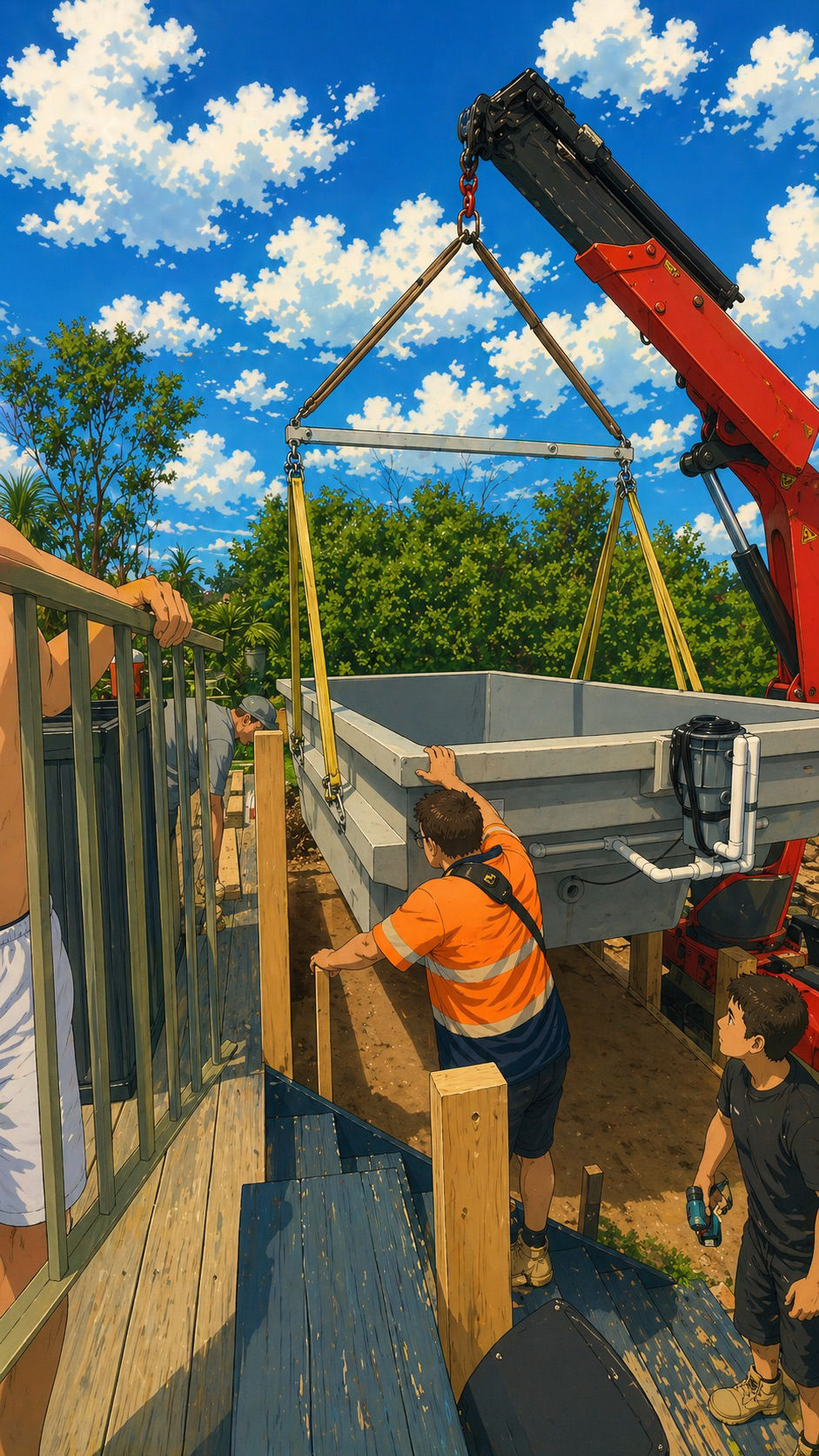
Magic Glasses: Working from the Hiab Deck
At first glance, standing on the Hiab deck to run the remote can look efficient and controlled. When you put on the Magic Glasses, you start to see that you are not just standing near the lift - you are standing on part of the system that is being loaded. The difference comes from understanding how forces move through the truck, not just through the crane.
Quick Scene-Setter
A Hiab truck arrives to place materials on site. The operator climbs onto the deck to rig the load and keeps the remote in hand while lifting. From this position, the operator has a clear view of the load and the landing area. Everything appears stable and routine.

What Most People See
The operator has good visibility of the load.
The remote allows precise control.
The stabiliser legs are deployed.
The job looks tidy and under control.
From a first look, it feels practical and low risk.

What the Magic Glasses Show You
1) You are at height, but your focus is on the load
The truck deck is not a work platform. It is an elevated surface with edges, limited space, and trip hazards.
Once the lift starts:
attention shifts to the load,
awareness of footing and edges reduces,
balance adjustments happen automatically, not deliberately.
A slip, misstep, or unexpected movement can result in a fall before there is time to respond.
2) You are operating from a surface that is being loaded
A Hiab does not become stable simply because the stabilisers are down.
Hiab stability is a combined system of:
stabiliser legs,
the truck chassis,
suspension, axles, and tyres,
the ground supporting all of the above.
Unlike a mobile crane with outriggers, the wheels and axles remain part of the stability picture. As you boom, slew, and extend, the load moment changes continuously. That load transfer can:
increase pressure through stabilisers and tyres,
cause subtle rocking or chassis movement,
change the surface you are standing on while you are operating the remote.
From the deck, you are standing on a platform that is actively reacting to the lift.
3) You can see the load, but not the full stability picture
Standing on the deck often improves visibility of the load while reducing visibility of what keeps the truck upright.
You may not see:
a stabiliser pad starting to sink or dish,
a stabiliser foot bridging a service or soft edge,
a tyre unloading as the radius increases,
the truck leaning as the load moves through different positions.
The risk is not the load alone. The risk is losing awareness of how the truck is behaving underneath you.
“I Can Feel It If Something Changes”
Experienced operators will often say that standing on the deck lets them feel changes through the truck. There is some truth in that. Vibration, movement, and load transfer can be felt through your feet.
The issue is timing.
By the time you can feel a change:
load transfer has already occurred,
stabilisers or tyres have already reacted,
the truck has already moved.
At that point, you are not detecting a developing issue. You are reacting to one that is already happening.
There is also a trade-off:
what you gain in feel,
you lose in balance margin, fall protection, and the ability to step away cleanly.
Standing on the ground may reduce what you feel through your feet, but it gives you:
a stable stance,
clearer awareness of truck lean and stabiliser behaviour,
time and space to stop the lift before a small change becomes a problem.
Good judgement is not about proving you can manage movement. It is about choosing a position that does not require you to manage it.

Operator Judgement - Seeing the Whole System
As the operator, you are responsible for the safety of the Hiab and the load. That responsibility requires you to judge the entire system, not just the lift path.
If you are only watching the load, you are not watching:
your footing,
truck movement,
stabiliser performance,
changes in ground response.
Good Hiab operation is not about standing where the load looks best. It is about choosing a position that allows continuous judgement of all the factors that keep the truck upright and people safe.
The Controls That Matter
Practical controls that reduce fall risk and stability risk together:
Select a defined operator position on the ground
firm and level footing,
clear of unprotected edges,
free of trip hazards.
Do not operate the remote while relocating
stop crane functions,
move to the new position,
re-enable control once stable.
Confirm the full stability system
stabilisers correctly set,
pads used where required,
ground checked for softness, services, and edges,
tyres and axles are considered as load-bearing components.
Maintain full situational awareness
clear view of stabilisers and support points,
clear view of exclusion zones.
Use a dogman or spotter where required
especially when ground-level visibility is limited,
Agree on communication before lifting.
Set the job up so you do not need to chase the load
plan landing zones,
establish exclusion zones early,
choose an operator position that stays safe for critical movements.
Magic Glasses Checklist - Working from the Hiab Deck
Am I standing on stable ground rather than on the deck?
Is there any unprotected edge or fall hazard near my position?
Can I clearly see stabilisers, pads, and the support surface?
Have I considered tyres and axles as part of the stability system?
Will I need to move while operating the remote?
Does my position allow me to stop the lift immediately if something changes?
Do I need a dogman or spotter to maintain full visibility?
Are exclusion zones in place and maintained?
Have I set the lift up so I can remain in one safe position?
Working from the Hiab deck often looks controlled because the load is easy to see.
The Magic Glasses reveal that the deck is part of a loaded, moving system, not a neutral place to stand.
This is a judgement skill that can be learned.
Next time, pause before lifting and ask one question: where can I stand to see and manage the whole Hiab system, not just the load?
Magic Glasses: The magic glasses come from the reality of - when I look at my books, I don't see a problem. But when my accountant looks at the books, it's a whole different story. He must have a special set of glasses.
As PCBU's, Officers and Workers, we have an obligation to learn what we are up to and the risks. Our actions and the standards we accept also affect those around us. This magic glasses post is made to help others see what we see.